How to Choose Folding Wagons for Wholesale: Capacity, Wheels and Frame
Folding wagons have moved from a beach accessory to an all-year bestseller. Families use them for camping, picnics, beach days and sports events; gardeners use them around the yard; and market traders use them to move stock. For retailers and outdoor distributors, a good wagon range brings a high ticket item that customers can see the value of straight away.
This guide explains how to choose folding wagons for wholesale: capacity and load, wheels for different ground, frame and fabric, useful features, what to check on samples, and how wagons are packed and shipped.
undefined1. Capacity and load: two different numbers
Wagons are sold by volume (litres) and by maximum load (kg). Volume tells the customer how much fits inside; load tells them how much weight the frame and wheels can carry. Always show both on the packaging, because customers compare them.
| Size | Typical volume | Typical use |
|---|---|---|
| Compact | 55–80 L | Shopping, short trips, small gardens |
| Standard | 100–150 L | Picnics, sports events, general family use |
| Large | 180–230 L | Camping, beach days, heavier loads |
| Two-tier / extended | 230–260 L | Large families, events, vendors |
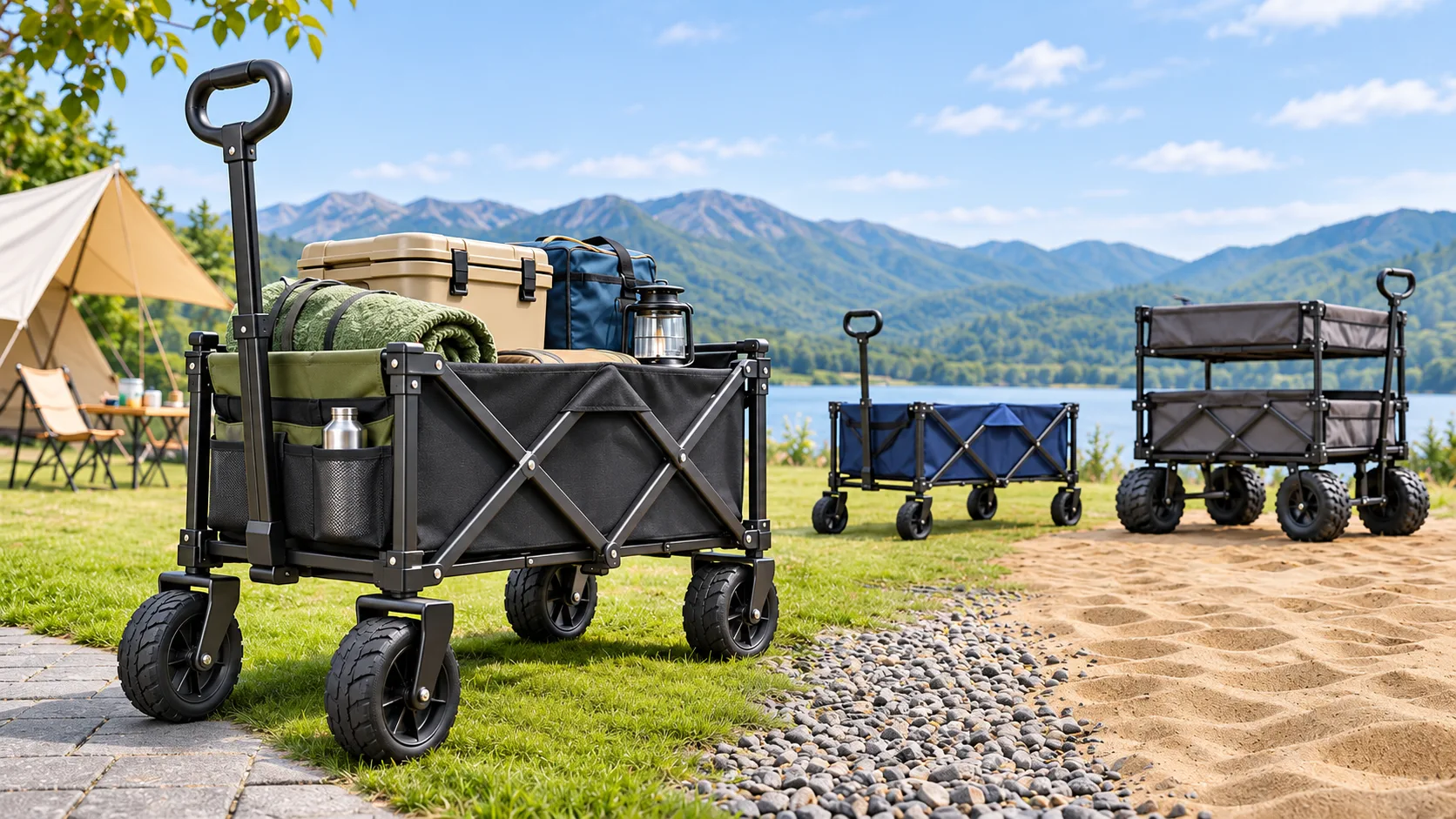
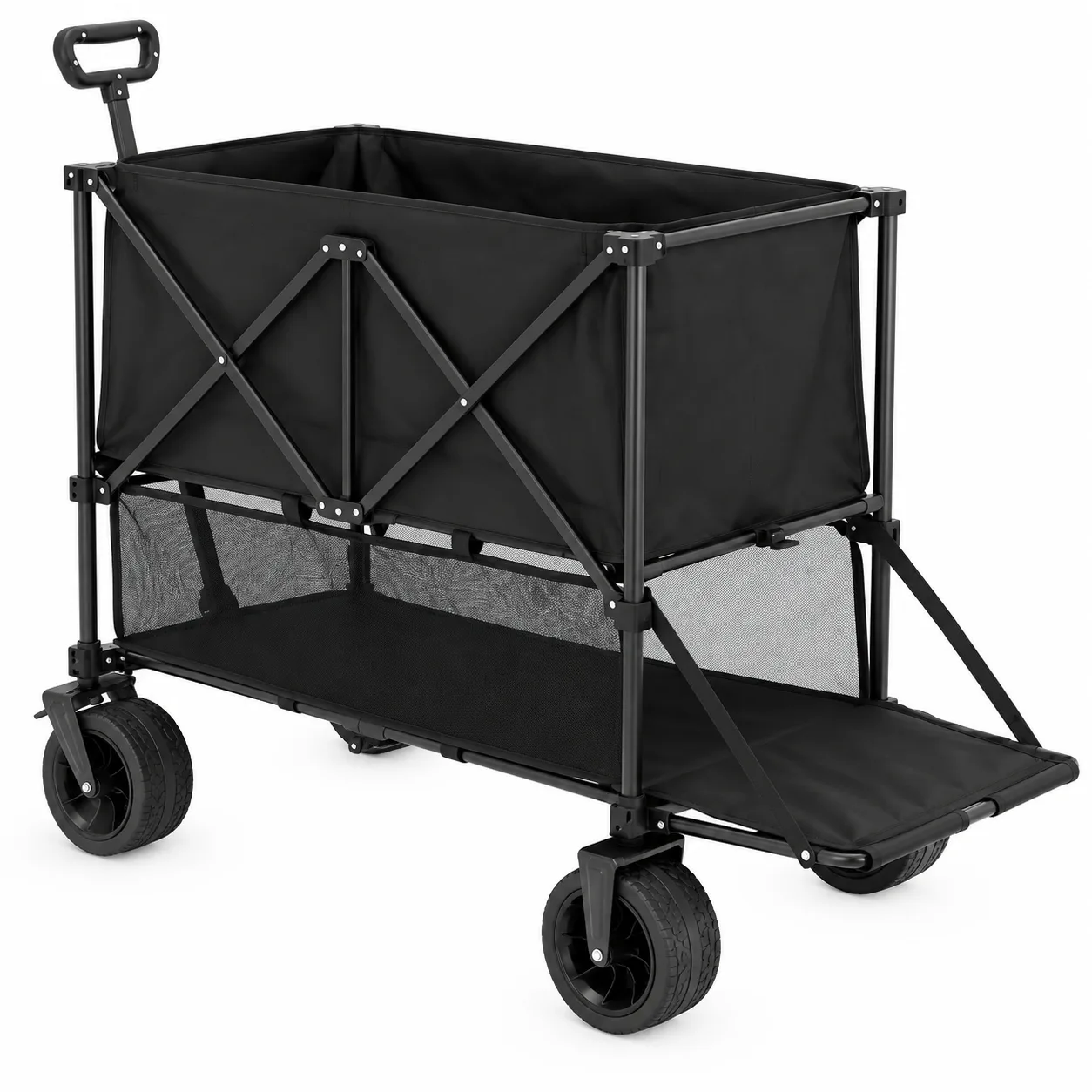
In our range, for example, the collapsible wagon with brakes comes in 109 L and 180 L versions rated for 100 kg, while the two-tier folding wagon offers 260 L across an upper bed and a lower section.
2. Wheels decide where the wagon can go
Wheels are the feature customers notice first, and the one most linked to complaints. Match the wheels to the ground your customers use:
- Standard PP/PVC wheels (around 6″ x 3″): fine for pavements, grass and park paths. Lower cost and lighter.
- Wider wheels (around 7″ x 4″): more stable on rough ground and gravel, better for heavier loads.
- Inflatable balloon wheels (around 9″ x 4.5″): roll over soft sand and rough ground. The right choice for beach and all-terrain wagons, such as our beach wagon with balloon wheels.
Foot brakes on the rear wheels are a useful selling point for slopes and for parking the wagon when loading.
3. Frame and fabric of folding wagons
Most folding wagons use a painted steel frame with a removable fabric bed. Check the frame tube thickness, the quality of the paint against rust, and how smoothly the frame folds and locks. For the fabric, 600D (D stands for denier) Oxford is a common, durable choice; look for even stitching, reinforced corners and a firm base panel so the bed does not sag under load.
4. Features that help the wagon sell
- Drop-down tailgate: makes loading easier and extends the bed for long items.
- Spring handle that stays upright: the handle does not fall to the ground when released, which customers notice in store.
- Canopy: shade for children or goods; can be offered as an add-on.
- Side pockets and cup holders: small details that add perceived value.
- Compact fold: customers want it to fit in a car boot, so give the folded size on the box.
5. What to check on samples
- Fold and unfold several times: the frame should open and lock without force or sharp pinch points.
- Load test: load close to the rated weight and pull it over rough ground. The frame should not bend and the wheels should not wobble.
- Wheels and axles: wheels turn freely, axles are secured, inflatable wheels hold pressure.
- Fabric and stitching: no loose seams, the bed sits tight on the frame.
- Handle: comfortable grip, spring return works, no play at the joint.
- Labels: capacity, maximum load and safety warnings are clear and correct for your market.
6. Packing and shipping
Wagons are usually packed one per carton, so they take up space in a container. Plan your order by container volume rather than by piece count, and ask for carton dimensions and gross weight early. Mixing two or three wagon models in one container, or combining wagons with other outdoor items such as camping furniture and cookware, helps fill space efficiently.
Questions to ask your wagon supplier
- What are the volume and the maximum load for each model?
- What size and type of wheels are fitted, and are brakes included?
- What fabric and frame tube are used?
- Can the fabric colour and logo be customised, and at what MOQ?
- What are the carton size and gross weight, and how many fit in a 40HQ container?
- How long do samples take, and is the sample cost refundable?
FAQ about folding wagons
What is the most popular folding wagon size?
Standard wagons around 100–150 L sell to the widest group of customers. Larger 180 L and two-tier models are popular for camping, beach use and big families.
Which wheels are best for the beach?
Wide inflatable balloon wheels. They spread the weight and roll over soft sand where standard wheels sink.
Can the wagon fabric be printed with our logo?
Yes. Fabric colour and logo printing are common customisations for private label wagon programs. MOQ depends on the model and the customisation.
What is the MOQ for ROSABEL folding wagons?
Our MOQ for in-stock items is 100 pcs. Samples are usually ready in 5–7 days, and the sample cost is refunded against your bulk order.
undefinedTalk to us about folding wagons
We supply compact, standard, large, all-terrain, beach and two-tier folding wagons, plus canopies. Tell us your market and price level, and we will suggest models and send carton details for container planning.