Locking Pliers Guide: Types, Sizes and How They Work
Locking pliers are adjustable pliers that lock onto a part and hold it without being squeezed, so they work like a pair of pliers and a clamp in one tool. Once set, they hold a part on their own, so the user has both hands free to weld, drill, cut or turn a stuck bolt. That is why mechanics, welders, fabricators and farmers keep several types in the toolbox, and why locking pliers are a steady seller in any hand tool range.
This guide explains how locking pliers work, the main jaw types, which sizes to stock and what to check on samples before you order.
What are locking pliers?
Locking pliers are pliers that clamp onto a part and lock in place, so they keep gripping after you let go. An adjusting screw in the handle sets the jaw opening and clamping force, and a release lever opens the jaws again. They are also called lock-grip or vise-type pliers. Mechanics, welders, plumbers and DIY users use them to hold parts hands-free, free seized nuts and bolts, and clamp work for welding or drilling.
How locking pliers work
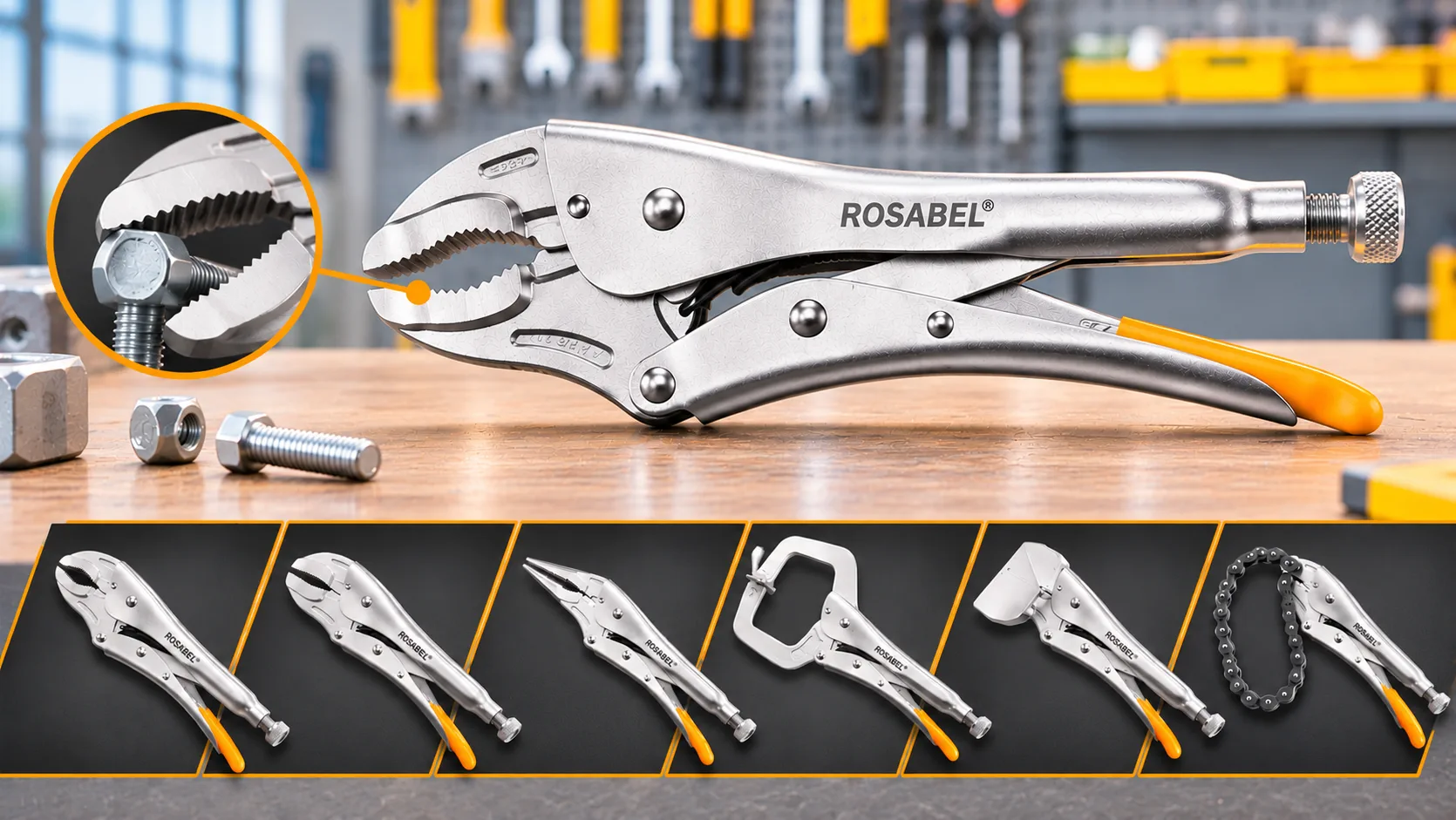
Locking pliers use an over-centre toggle mechanism. The adjusting screw at the end of the handle sets the jaw opening and the clamping force. When the handles are squeezed, the linkage passes a dead point and locks; the jaws then stay closed without hand pressure. A release lever opens them again in one movement.
- Turn the adjusting screw until the jaws just touch the part.
- Squeeze the handles until they snap closed. If they close too easily, tighten the screw a little; if they will not close, loosen it.
- Press the release lever to open.
Types of locking pliers at a glance
| Type | Jaw shape | Best for |
|---|---|---|
| Curved jaw | Curved jaws with teeth, often with a wire cutter | Round, hex and flat parts; stripped bolts and nuts; general repair |
| Straight jaw | Flat parallel jaws | Flat stock and square parts |
| Long nose | Long, narrow jaws | Small parts in tight or deep spaces |
| C-clamp | Wide C-shaped jaws with swivel pads | Holding parts together for welding, drilling and gluing |
| Sheet metal | Wide flat blades | Bending, folding and holding sheet metal |
| Chain | Chain that wraps round the part | Pipes, large or irregular shapes |
| Welding (U-jaw) | Deep U-shaped jaws | Holding pieces around a weld seam |

Which sizes to stock
| Size | Typical use |
|---|---|
| 5″ (125 mm) | Small parts, electronics, hobby and model work; often sold as a mini set |
| 7″ (180 mm) | Compact all-round size for home and auto toolkits |
| 10″ (250 mm) | The best-selling size: workshops, auto repair and farm use |
| 11″ (280 mm) and larger | C-clamp, sheet metal and welding types |
A strong starting range is a 10″ curved jaw, a 7″ curved jaw, a long nose and a C-clamp model. Add sheet metal, chain and welding types for professional and industrial customers.
Locking pliers vs other pliers
- Locking pliers vs water pump pliers: water pump (tongue and groove) pliers adjust quickly and suit plumbing, but the user has to keep squeezing. Locking pliers hold by themselves.
- Locking pliers vs clamps: a C-clamp gives more reach and pressure, but locking pliers are faster to set and release with one hand.
What to check on samples
- Locking action: the pliers should lock with a clear snap and hold the part firmly without slipping.
- Release: the release lever should open the jaws easily, even after locking at high force.
- Jaw teeth: teeth should be sharp, even and hardened; on curved jaws, check that they bite on a round bar and a hex nut.
- Rivets and links: there should be no side-to-side play in the jaws or linkage.
- Adjusting screw: it should turn smoothly and not loosen by itself during use.
- Wire cutter: if fitted, it should cut soft wire cleanly.
Our locking pliers
We supply locking pliers for wholesale, OEM and private label, with MOQ from 100 pcs per item for in-stock models:
- Industrial Locking Pliers, 10″: curved jaws that grip round, flat and hex shapes, with quick-release lever.
- Curved Jaw Locking Pliers and Locking Pliers with Soft Grip, 10″ for everyday workshop use.
- Long Nose Locking Pliers, 9″: long, narrow jaws with a built-in wire cutter.
- C-Clamp Locking Pliers and Sheet Metal Locking Pliers, 10″ for welding and bodywork.
- Chain Locking Pliers, 10″: the chain wraps round pipes and irregular shapes.
- 2-Piece Mini Locking Pliers Set for small parts and gift ranges.
See all our pliers, clamps and holding tools.
FAQ about locking pliers
What are locking pliers used for?
Holding parts in place without hand pressure: clamping work for welding or drilling, gripping stripped bolts and nuts, holding pipes, and acting as a temporary handle or clamp.
What size locking pliers is most popular?
The 10″ (250 mm) curved jaw model is the most popular size worldwide. The 7″ size is common in home and car toolkits.
How do you adjust locking pliers?
Turn the screw at the end of the handle until the jaws touch the part, then squeeze the handles to lock. Tighten the screw for more force or loosen it if the handles will not close.
What are locking pliers called in Spanish?
In Mexico they are usually called pinzas de presión; in Chile and Spain, alicate de presión.
Can you supply locking pliers with our brand?
Yes. We can laser-mark or print your logo, choose handle colours and design your hanging card or packaging. Tell us your quantity and we will confirm the MOQ.
Talk to us about locking pliers
Tell us your market, the types and sizes you need and whether you want your own brand. We will recommend models, send samples in 5 to 7 days and quote within 24 hours.