Tape Measure Guide: Types, Sizes, Markings and Accuracy Classes
The tape measure is the tool almost every buyer orders and almost every end user owns, which is exactly why the details matter. Two tapes that look the same on a shelf can differ in blade width, standout, markings and accuracy, and those are the things professionals notice after a week on site.
This guide explains the main types of tape measures, which sizes and markings to stock for each market, how accuracy classes work and what to check on samples before you order.
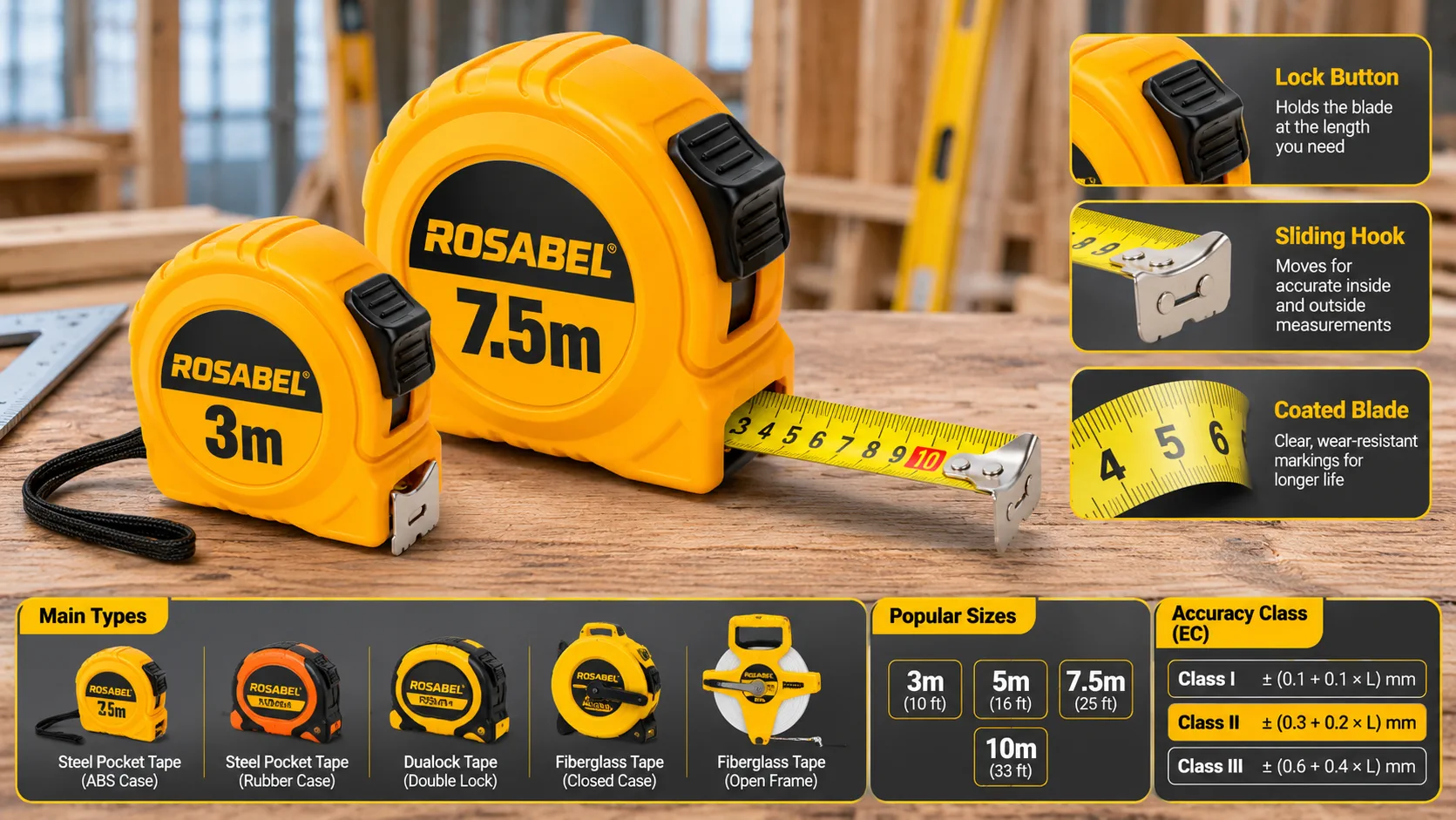
Types of tape measures at a glance
| Type | Typical lengths | Best for |
|---|---|---|
| Steel pocket tape, ABS case | 3–10 m (10–33 ft) | DIY, retail, promotional and general trade ranges |
| Steel pocket tape, rubber-covered case | 3–10 m | Building sites: the case survives drops and gives a firm grip |
| Double-lock (dualock) tape | 3–10 m | Professionals who need the blade held out at a fixed length |
| Fiberglass long tape, closed case | 20–50 m | Surveying plots, sports fields, landscaping and fencing |
| Fiberglass long tape, open frame | 30–100 m | Construction layout and site work; easy to clean when muddy |
Length and blade width: what sells
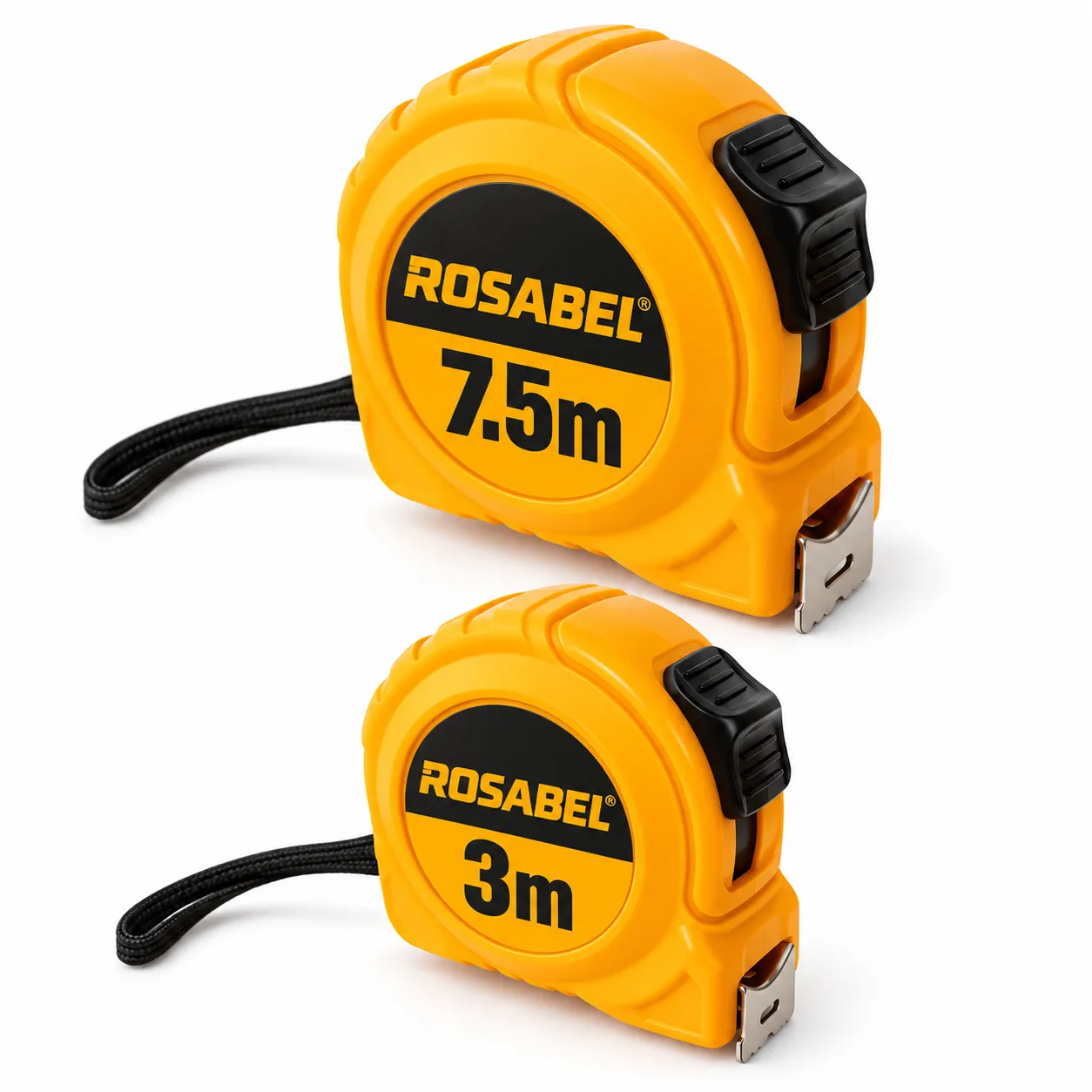
Pocket tapes are sold by length and blade width together, for example 5 m x 25 mm. A wider blade has more standout, meaning it can be pushed further across a gap before it bends, which is what carpenters and builders want.
| Size | Blade width | Typical customer |
|---|---|---|
| 3 m (10 ft) | 13–16 mm | Home, DIY, tool kits and gift sets |
| 5 m (16 ft) | 19–25 mm | The best-selling all-round size in most markets |
| 7.5–8 m (25–26 ft) | 25 mm | Carpenters and builders; the standard pro size in North America |
| 10 m (33 ft) | 25–32 mm | Site work, flooring and longer measurements |
A practical starting range is 3 m, 5 m and 7.5 m. Add 10 m for trade and construction customers.
Markings: metric, inch or both
- North America: feet and inches, usually with 16-inch stud marks and often a metric scale on the lower edge.
- Europe: metric only or metric and inch. Tapes sold in the EU are often marked with an EC accuracy class.
- Latin America: metric and inch on the same blade is the most common choice, since both systems are used in trade.
- Middle East, Africa and Asia: usually metric, often with inch on the lower edge.
Blade colour also matters: a yellow or white blade with black and red numbers is the easiest to read. A nylon or matte coating protects the print from wear.
Accuracy classes explained
In Europe, tape measure accuracy is defined by the EC classes from the Measuring Instruments Directive. The permitted error grows with the measured length:
| Class | Maximum permitted error | Example at 5 m |
|---|---|---|
| Class I | ± (0.1 + 0.1 x L) mm | ± 0.6 mm |
| Class II | ± (0.3 + 0.2 x L) mm | ± 1.3 mm |
| Class III | ± (0.6 + 0.4 x L) mm | ± 2.6 mm |
L is the length in metres, rounded up to the next whole metre. Class II is the usual standard for professional pocket tapes. If your market requires a class marking, tell us before sampling so we can confirm the blade and documents with our factory.
The hook: why it moves
The end hook on a pocket tape slides slightly on its rivets. This is not a fault: the hook moves by its own thickness so that the tape reads correctly both for inside measurements (hook pushed in) and outside measurements (hook pulled out). This is called true zero. On samples, check that the hook moves freely but does not wobble sideways, and that it is firmly riveted.
What to check on samples
- Accuracy: compare the sample against a reference rule at several points, for example 1 m, 3 m and full length.
- Standout: extend the blade horizontally and note where it bends. Wider blades should go noticeably further.
- Lock: the lock should hold the blade without slipping, and the return should be smooth, not violent.
- Drop test: drop the tape from waist height onto concrete a few times; the case should not crack and the blade should still retract.
- Print: check that numbers are sharp, the scale is correct for your market and your logo is clear on the case.
Our tape measures
We supply tape measures for wholesale, OEM and private label, with MOQ from 100 pcs per item for in-stock models:
- Measuring Tape, Yellow ABS Case: 3 m, 5 m, 7.5 m and 10 m, with belt clip, lock button and metric and inch markings.
- Measuring Tape, Rubber Case: the same sizes in a rubber-covered case for building sites.
- Dualock Measuring Tape: double lock to hold the blade, rubber-covered case, 3 m to 10 m.
- Fiberglass Measuring Tape, Closed Case: 20 m, 30 m and 50 m with fold-out rewind handle.
- Fiberglass Measuring Tape, Open Frame, 50 m: for site layout and landscaping.
See all our measuring, marking and layout tools.
FAQ about tape measures
What size tape measure is best?
A 5 m (16 ft) tape with a 19 to 25 mm blade suits most users. Carpenters and builders often prefer 7.5 to 8 m (25 to 26 ft) with a 25 mm blade.
Why does the hook on a tape measure move?
The hook slides by its own thickness so the tape reads correctly for both inside and outside measurements. This is called true zero and is a normal feature.
What is a Class II tape measure?
Class II is an EC accuracy class used in Europe. The maximum error is ± (0.3 + 0.2 x L) mm, where L is the length in metres, so about ± 1.3 mm at 5 m.
What is a tape measure called in Spanish?
In Mexico it is usually called flexómetro; in Chile, huincha de medir; in Spain and Argentina, cinta métrica. Long fiberglass tapes are often called cinta métrica de fibra de vidrio.
Can you print our logo and scale on the blade?
Yes. We can print your logo on the case and blade, adapt the scale to your market and design your packaging. Tell us your quantity and we will confirm the MOQ.
Talk to us about tape measures
Tell us your market, the sizes and markings you need and whether you want your own brand. We will recommend models, send samples in 5 to 7 days and quote within 24 hours.