Combination Pliers vs Linesman Pliers: Differences, Uses and How to Choose
Ask a buyer in Germany and a buyer in Texas for “the everyday plier,” and you may get two different tools. Europeans usually mean combination pliers. Americans usually mean linesman pliers (also written lineman’s pliers). The two look similar and do similar jobs, but the differences matter when you plan a range, write a product listing or answer a customer who asks which one to buy.
In this guide we compare combination pliers vs linesman pliers: how they differ, what each one is best for, and what to check before you order them for your market.
Combination pliers vs linesman pliers: the short answer
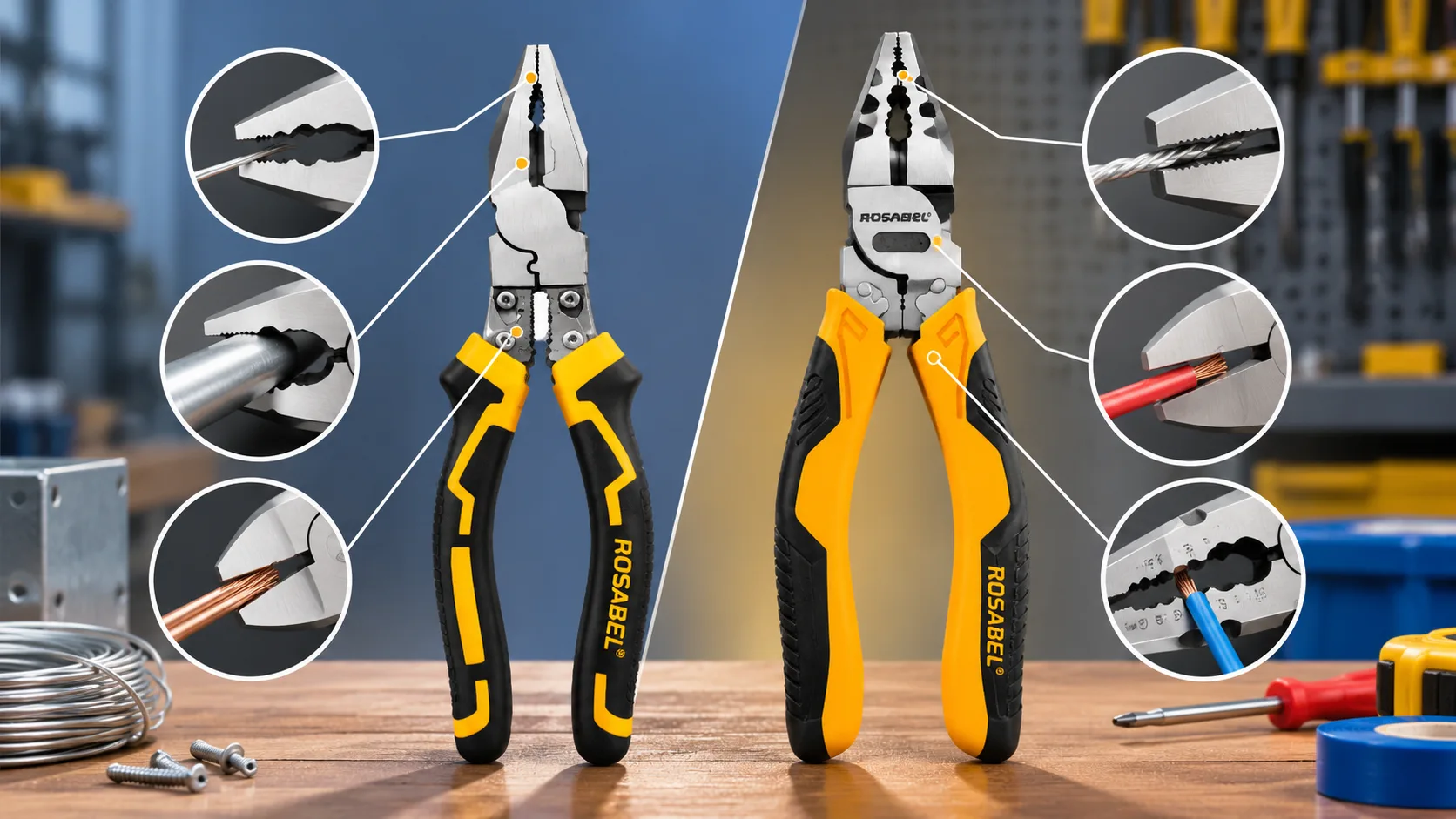
Both are general-purpose pliers that grip, cut and bend wire. Combination pliers have a slightly rounded jaw with a serrated gripping zone near the tip, a pipe-gripping area in the middle and side cutters near the joint. Linesman pliers have a heavier, flat, square nose built for twisting and cutting electrical wire, with the cutters close to the tip of the head for extra power. In practice, many modern pliers combine features of both.
| Combination pliers | Linesman pliers | |
|---|---|---|
| Main markets | Europe, Asia, Latin America | United States and Canada |
| Head shape | Slightly rounded jaw, narrower nose | Flat, square, heavier nose |
| Gripping | Serrated tip plus a round pipe-gripping zone | Flat serrated jaws for twisting wire together |
| Cutting | Side cutters near the joint | Powerful cutters, often with high-leverage geometry |
| Typical sizes | 160, 180 and 200 mm (about 6 1/4″, 7″ and 8″) | 8″, 9″ and 9 1/2″ |
| Common extras | Crimping area, wire stripper on multifunction models | Crimper, stripper, sometimes a fish-tape puller |
| Main users | General trades, maintenance, DIY, electricians | Electricians and utility workers |

What are combination pliers?
Combination pliers are the classic all-round plier in Europe. In Spanish-speaking markets they are called alicate universal. The jaw combines several jobs in one tool: the serrated tip holds small parts, the curved middle section grips round material such as pipe or bar, and the side cutters cut soft and medium-hard wire.
In Europe, combination pliers are usually specified against DIN ISO 5746, which sets the dimensions and the test loads for gripping and cutting. Many retailers and tender buyers ask for this standard, so it is worth checking with your supplier before you order.
Typical buyers: hardware stores, builders’ merchants, industrial suppliers and DIY chains. The 180 mm and 200 mm sizes sell best in most markets.
What are lineman (linesman) pliers?
Linesman pliers were developed for electrical line work, where users twist and cut thicker copper and aluminium conductors all day. The flat, square nose lets the user twist wires together firmly, and the heavy head gives the leverage needed for repeated cutting. Many US models add a crimping area and wire-stripping holes behind the joint.

Typical buyers: electrical wholesalers, contractors’ supply stores and home centres in North America. The 9″ and 9 1/2″ sizes are the professional favourites; 8″ models suit general and DIY use.
Which one should your customers use?
- Electricians in North America: linesman pliers. Their flat nose and cutting power are what the trade expects.
- General trades and maintenance: combination pliers. The rounded jaw handles a wider mix of jobs, from pipe to small fasteners.
- Electricians in Europe and Latin America: combination pliers or multifunction combination pliers with a built-in stripper and crimper.
- DIY and promotional ranges: an 8″ combination or linesman plier is usually enough. Focus on comfortable handles and clear packaging.
A simple way to cover both: stock a combination plier as your all-round tool and a multifunction plier for electrical work, so customers can choose by job.
Insulated versions for live electrical work
Standard two-colour or dipped handles are for comfort and grip, not for electrical protection. If your customers work on live circuits, they need insulated pliers tested to IEC 60900 (often marked 1000V or VDE). These are a separate product, so keep them clearly apart in your range and listings.
What to check on samples
- Joint: the pliers should open and close smoothly, with no side play.
- Jaw alignment: the tips should meet exactly and not cross when you squeeze hard.
- Cutting edges: they should close fully up to the tip. Test them on the wire your customers really cut, not only soft copper.
- Handles: grips should be firmly fixed and comfortable with work gloves.
- Marking and packaging: size, material and your brand should be clear on the tool and the card.
Our combination and linesman pliers
We supply both styles for wholesale, OEM and private label, with MOQ from 100 pcs per item for in-stock models:
- Industrial Combination Pliers, 8″: CR-V steel, side cutter and crimping area, two-colour industrial handles.
- Multifunction Combination Pliers, 9″: grip, cut, strip and crimp in one tool.
- Multipurpose Lineman Pliers, 8.5″: wire cutter, stripper and crimper with soft-grip handles.
- 7 in 1 Cable Pliers, 8″: seven functions for cable work.
See all our pliers, clamps and holding tools.
FAQ about combination and linesman pliers
Are combination pliers and linesman pliers the same?
No, but they are closely related. Both grip and cut wire. Linesman pliers have a flatter, heavier nose for twisting and cutting electrical wire; combination pliers have a rounder jaw that also grips pipe and small parts.
What is a combination plier called in Spanish?
In most Spanish-speaking markets it is called alicate universal.
Which size of combination pliers sells best?
In most markets, 180 mm (7″) and 200 mm (8″) are the best sellers. 160 mm suits light work and smaller hands.
Can linesman pliers be used for live electrical work?
Only if they are insulated pliers tested to IEC 60900. Standard handles do not protect against electric shock.
Talk to us about pliers
Still deciding between combination pliers vs linesman pliers for your range? Tell us your market, the sizes you need and whether you want your own brand. We will recommend models, send samples in 5 to 7 days and quote within 24 hours.